Her Story of Faith and Service
Maria’s Journey of Courage
Maria (Ma-rye-uh) Fearing was born into slavery on July 26, 1838, in Gainesville, Alabama. Her early life was shaped by hardship, yet also by a quiet determination to learn and grow. After the Civil War and emancipation, Maria pursued the education that had been withheld from her. Working as a domestic servant to pay tuition, she enrolled at Talladega College, one of the first institutions to educate freed African Americans.
At a time when opportunities for Black women were scarce, Maria’s perseverance stood out. She earned her degree in her thirties and later became a teacher, sharing her love of learning with children who, like her, had once been denied access to education. Her story is one of faith overcoming barriers, a reminder that knowledge and freedom walk hand in hand.
Answer the Call
Maria’s faith deepened as she taught and served within the Presbyterian Church, and in her fifties, she felt a stirring she could not ignore, a call to mission service in Africa. Many around her thought the idea impossible. She was a Black woman in the Reconstruction-era South, long past the age most missionaries were sent abroad. But Maria Fearing’s faith was stronger than fear.
When the Presbyterian Board of Missions initially denied her request to serve because of her age, she refused to give up. She saved her own earnings, raised funds from her congregation, and at the age of 56, she sailed to the Congo. There she joined Rev. William Henry Sheppard, another trailblazing African American missionary whose courage and advocacy would later expose atrocities committed under colonial rule. Together, they worked alongside others at the Luebo Mission, teaching, translating Scripture, and building relationships rooted in compassion and mutual respect.
Maria’s partnership with Sheppard and her deep love for the people of the Congo revealed the fullness of her calling: not just to preach faith, but to live it through teaching, healing, and community-building. Her determination to serve reminds us that when God calls, no obstacle , not age, gender, or circumstance, can stand in the way.
Living Her Faith
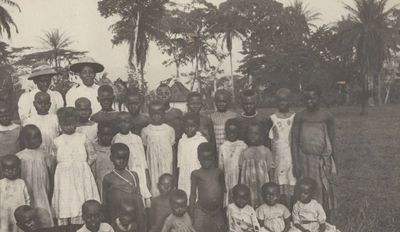
For more than two decades, Maria Fearing lived and served in the Congo, dedicating her life to education, care, and Christian witness among the people she loved. Alongside Rev. William Henry Sheppard and other Presbyterian missionaries at the Luebo Mission, she became part of a remarkable movement that combined faith, cultural respect, and community uplift.
Maria immersed herself in learning the local language and customs so she could teach and serve with understanding. Her days were filled with teaching children to read and write, leading Bible lessons, caring for the sick, and nurturing those who had been cast aside. To the Congolese people, she became affectionately known as “Mama wa Moyo,” meaning Mother from America, a title that reflected her warmth and unwavering presence.
Her most enduring contribution was the creation of the House of Hope, a home and school she founded for girls rescued from slavery, abuse, and abandonment. There, Maria offered safety, education, and the chance to dream again. She taught them practical skills like sewing and farming, alongside the spiritual and moral lessons that shaped their sense of self-worth.
Maria’s partnership with Sheppard helped extend the mission’s reach, as both sought to bring dignity, justice, and faith to those suffering under colonial oppression. Together, they modeled what it meant to serve humbly and courageously in a world deeply divided by race, power, and inequality. Her work in Africa was not just missionary labor, it was a ministry of liberation, love, and lasting transformation.
Honoring a Life of Impact
When Maria Fearing returned to Alabama after more than twenty years in Africa, she carried with her stories of faith, endurance, and transformation. She continued to teach and serve, devoting her later years to education and mentoring young people in the same spirit that had guided her overseas. Even in her nineties, she was known for her sharp mind, radiant spirit, and unwavering belief that education could change lives.
Maria passed away in 1937 at the age of 99, leaving behind a legacy that continues to inspire generations. Her life bridged continents and cultures, from a plantation in Alabama to mission fields in the Congo, and her impact was both local and global. In 2000, she was inducted into the Alabama Women’s Hall of Fame, honored for her groundbreaking contributions to faith, education, and social justice.
Her name endures not only in history books but in the living ministry of those who follow in her footsteps. Through her courage, the Presbyterian Church and countless believers learned that mission work is not bound by age, status, or circumstance, it is bound by faith and love in action.
Inspired by Faith
At the heart of Maria Fearing’s life was an unshakable faith, a faith that taught her to trust God’s timing and to serve with joy, even when the path was uncertain. She began her missionary journey at an age when many thought her calling had passed, yet she showed that obedience to God’s voice can open doors that the world tries to close.
Her favorite Scriptures spoke of perseverance and purpose, echoing the words of Galatians 6:9 — “Let us not grow weary in doing good, for in due season we shall reap, if we do not give up.” This verse became the rhythm of her life. Through her teaching, care, and faithfulness, she planted seeds that continue to bear fruit in the lives of others.
Today, the Maria Fearing Fund carries forward that same spirit , empowering women, educating youth, and uplifting communities through faith and action. Just as Maria answered her call with courage, we are called to continue her mission: to build hope where there is despair, light where there is darkness, and opportunity where there is need.